Water for Kids
The Cycle of Water
Water is essential to life. Without it, the biosphere that exists on the surface of the earth wouldn’t be possible. Nicknamed the “water” planet, Earth is covered by one of our most precious resources. However, almost 93% is locked in the oceans, toxic to humans and many plants and animals.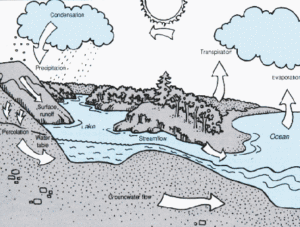
How do we obtain fresh water resources then? Where does drinkable water come from? To understand, we need to turn to the Hydrologic Cycle.
Water’s molecular arrangement is very simple, two hydrogens to each oxygen atoms, but this is misleading. Water has many unique properties that allow it to be such a universal material. One special characteristic of water is its ability to change state very easily under Earth conditions. It can be found readily on the planet in all of its three forms, solid, liquid, and gas. These forms also play a great part in the hydrologic cycle. Now, exactly what is the hydrologic cycle.? The hydrologic cycle takes place in the hydrosphere, this is the region containing all the water in the atmosphere and on the surface of the earth. The cycle is the movement of water through this hydrosphere.
Now the entire process is very simple, divided in to five parts
- Condensation
- Infiltration
- Runoff
- Evaporation
- Precipitation
The process begins with condensation, when water vapor condenses in the atmosphere to form clouds. Condensation occurs when the temperature of the air or earth changes. Water changes states 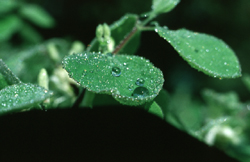 when temperatures fluctuate. So when the air cools enough, water vapor has to condense on particles in the air to form clouds. This process is very noticeable on plants as they dew in the morning.
As clouds form, winds move them across the globe, spreading out the water vapor. When eventually the clouds can’t hold the moisture, they release it in the form of precipitation, which can be snow, rain, hail, etc.
The next three stages: infiltration, runoff, and evaporation occur simultaneously. Infiltration occurs when precipitation seeps into the ground. This depends a lot on the permeability of the ground.
Permeability is the measure of how easily something flows through a substance. The more permeable, the more precipitation seeps into the ground. If precipitation occurs faster than it can infiltrate the ground, it becomes runoff. Runoff remains on the surface and flows into streams, rivers, and eventually large bodies such as lakes or the ocean. Infiltrated groundwater moves similarly as it recharges rivers and heads towards large bodies of water.
As both of these processes are happening, the power of the sun is driving this cycle by causing evaporation. Evaporation is the change of liquid water to a vapor. Sunlight aids this process as it raises the temperature of liquid water in oceans and lakes. As the liquid heats, molecule are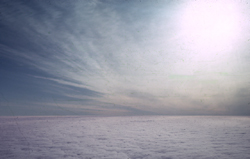 released and change into a gas. Warm air rises up into the atmosphere and becomes the vapor involved in condensation.
Considering so little of the water on earth is drinkable to people, it is amazing the supply has survived as long as it has. The hydrologic cycle continues to move water and keep sources fresh. It is estimated that 100 million billion gallons a year are cycled through this process. Without this process life on Earth would be impossible. We need it to sustain us and for all of our life processes to function. Without water, life would not be possible on Earth.
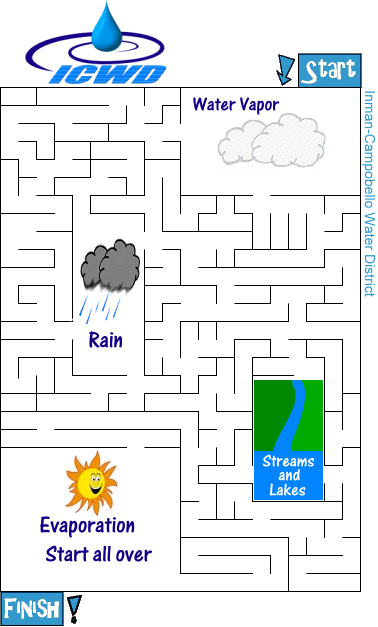
Water Cycle – Use the image below and trace the maze to complete the Cycle of Water.
Word Search
CIRCULATE: To move in a circle, circuit or orbit’ to flow without obstruction to follow a course that returns to the starting point. Water can circulate in a variety of ways.
CONDENSATION: The changing of a gas or vapor into a liquid. Water condenser.
CONSERVATION: To protect from loss and waste. Conservation of water means to save or store water for later use.
CONTAMINATION (WATER): Damage to the quality of water sources by sewage, industrial waste, or other matter.
DELTA: An alluvial deposit made of rock particles (sediment, and debris) dropped by a stream as it enters a body of water.
DESALINIZATION: The process of salt removal from sea or brackish water.
DISCHARGE: In the simplest form, discharge means outflow of water. The use of this term is not restricted as to course or location and it can be applied to describe the flow of water from a pipe or from a drainage basin.
DROUGHT: There is no universally accepted quantitative definition of drought. Generally, the term is applied to periods of less than average precipitation over a certain period of time; nature’s failure to fulfill the water wants and needs of man.
EVAPORATION: The process by which water becomes a vapor at a temperature below the boiling point.
FILTRATION: The mechanical process which removes particulate matter by separating water from solid material, usually by passing it through sand.
FLOW: The rate of water discharged from a source given in volume with respect to time, commonly measured in Gallons Per Minute (GPM)
GROUND WATER: The supply of fresh water found beneath the Earth’s surface (usually in aquifers) which is often used for supplying wells and springs. Because ground water is a major source of drinking water, there is growing concern over areas where leaching agricultural or industrial pollutants or substances from leaking underground storage tanks are contaminating ground water.
HYDROGEN: A chemical substance found in most fuels; by itself, a colorless gas that burns quickly. It is a major component of water.
RAIN: Water drops which fall to the earth from the air.
RESERVOIR: A pond, lake, tank, or basin (natural or human made) where water is collected and used for storage. Large bodies of ground water are called ground water reservoirs; water behind a dam is also called a reservoir of water.
RUN OFF: Water from rainfall or irrigation that is allowed to flow off the property. Run-off can be thought of as a lost resource and a contributor to pollution.
SURFACE WATER: Water on the earth’s surface exposed to the atmosphere, e.g., rivers, lakes, streams, oceans, ponds, reservoirs, etc.
WATER: The liquid that descends from the clouds as rain; forms streams, lakes, and seas, and is a major constituent of all living matter; is an odorless, tasteless, colorless, very slightly compressible liquid.
WATER CYCLE: The process by which water travels in a sequence from the air (condensation) to the earth (precipitation) and returns to the atmosphere (evaporation). It is also referred to as the hydrologic cycle.
Fun Facts


- Water that is safe to drink is called Potable.
- Water is composed of two elements: HYDROGEN and OXYGEN.
2 HYDROGEN + 1 OXYGEN = H20 Water! - There is the same amount of water on Earth now as there was when the Earth was formed. The water from your faucet could contain molecules that dinosaurs drank.
GROSS!! - Nearly 97% of the world’s water is salty or otherwise undrinkable. Another 2% is locked in ice caps and glaciers. That leaves just 1% for all of humanity’s needs – all its agricultural, residential, manufacturing, community, and personal needs.
- Water regulates the Earth
‘s temperature. It also regulates the temperature of the human body, carries nutrients and oxygen to cells, cushions joints, protects organs and tissues, and removes wastes.
 75% of the human BRAIN is water and 75% of a living tree is water.
-
- A person can live for about a month without food, but only about a week without water.
- Water expands by 9% when it freezes. Frozen water (ice) is lighter than water, which is why ice floats in water.
 One ear of corn is 80% water.
- On the average, 50% – 70% of SUMMER household water is used outdoors for watering lawns and gardens.
 Running the water while brushing your teeth wastes up to 4 gallons a minute.
- Almost 80% of the Earth’s surface is covered with water.
- A person can live for about a month without food, but only about a week without water.

- The BATHROOM is the room in the house where most water is used. (The toilet is the number one water-using appliance in the home).
Ask the Water Boys
Have a question about drinking water, the delivery process, the filtration process or just about anything else related to H20? Ask our “Water Boys”.