A Resilient Water Future:
ICWD’s New Water Treatment Plant
ICWD’s new water treatment plant will play a vital role in expanding their water sources to provide high-quality, affordable water for their growing community.
Inman-Campobello Water District (ICWD) has been experiencing significant growth, doubling the number of customers over the last 20 years. ICWD has historically purchased their drinking water from a third-party source, including neighboring utilities such as Spartanburg Water (SWS) and Broad River Water Authority (BRWA), their current water supplier. To meet their growth demands, ICWD needed to find an additional water source. ICWD had four options: purchase additional water from BRWA, purchase water from SWS, produce their own water in addition to current BRWA water, or build their own 8 MGD water treatment plant (WTP) and eliminate the need to purchase water from BRWA
Since 2002, ICWD has repeatedly evaluated the benefits of producing their own water to increase redundancy and reduce costs. However, purchasing additional water from either BRWA or SWS would require significantly upgrading their infrastructure because of capacity. After evaluating the costs, ICWD concluded that building its own WTP would be just as cost-effective as the infrastructure upgrades required for purchasing additional water.
So, to move forward with increasing their water supply, ICWD began designing a new WTP in 2021 that would produce 4 million gallons per day (MGD) with the potential to expand to 8 MGD, which is the maximum capacity of the North Pacolet River intake site.
In May 2024, construction began which includes two main components, the North Pacolet River intake facility, located in Fingerville, SC, and the WTP, located near Inman, SC, at the intersection of S.C. Hwy. 292 and Hickory Nut Road. With long-term planning in mind, ICWD designed the WTP to accommodate a future expansion up to 32 MGD.
Beyond increasing capacity, the new plant is also designed to continue providing water with a quality and taste that customers have come to trust. To do so, ICWD is using ceramic membranes instead of conventional filters to produce high-quality water. While unique to WTPs in the US, ceramic membranes are an advanced technology that is growing in popularity due to their ability to produce high quality water efficiently.
With the additional water source, large pipeline are necessary to convey water to and from ICWD’s system. Approximately 7 miles of large diameter pipeline is needed to transport water from the North Pacolet River to the WTP, and approximately another 4 miles is needed to transport the treated water from the WTP to the heart of ICWD’s distribution system, which is the Windmill Hill Tank system.
The project goes beyond the WTP and pipeline though. It’ll also include a new administration building and a new maintenance building. With the current administration building constructed in the 1970s and last expanded over 35 years ago, the new building will house a laboratory necessary for the WTP. Building these new facilities simultaneously will maximize resources and help meet the operational needs of the growing ICWD staff.
All of this wouldn’t be possible without the right funding. The ICWD received a $10 million grant towards the total cost of $65 million for the project, with $55 million being borrowed. Construction of the WTP is estimated to be completed in the spring of 2026, and the administration building, and maintenance building are estimated to be completed between fall 2025 and early 2026.
With the completion of the new WTP, ICWD will continue providing high-quality, affordable drinking water to their residents with the security of resiliency and the ability to meet future growth.
Click Here to View a Presentation
Frequently Asked Questions:
Why is it necessary to build a WTP?
Since ICWD is building a water treatment plant with the water coming from the North Pacolet River, where does my water come from now?
Will the water from the new WTP taste different than the water coming from BRWA?
quality similar to BRWA’s by using
advanced ceramic membranes,
unique to U.S. WTPs, for superior
filtration. ICWD will continue
purchasing water from BRWA
while using the WTP to supplement
supply, ensuring high quality and
fair cost for years to come.
So, once the new WTP is finished and fully operation, will ICWD still purchase water from BRWA?
water from BRWA while using the WTP
to meet growing demand. This dualsource
approach will be valuable during
droughts and provides redundancy,
ensuring reliable service if one source is
unavailable, aligning with the principle of
not “putting all your eggs in one basket.”
Will the WTP ever be expanded?
Where will the water come from once the 8 MGD limit is reached?
What are the routes for the raw water main and the finished water mains?
Why did the ICWD decide to build a new office and maintenance facility? Wouldn’t the current one and the WTP location be close enough to one another?
What will happen to the current ICWD office, maintenance buildings, and surrounding property?
This seems like a large project. How much will it cost?
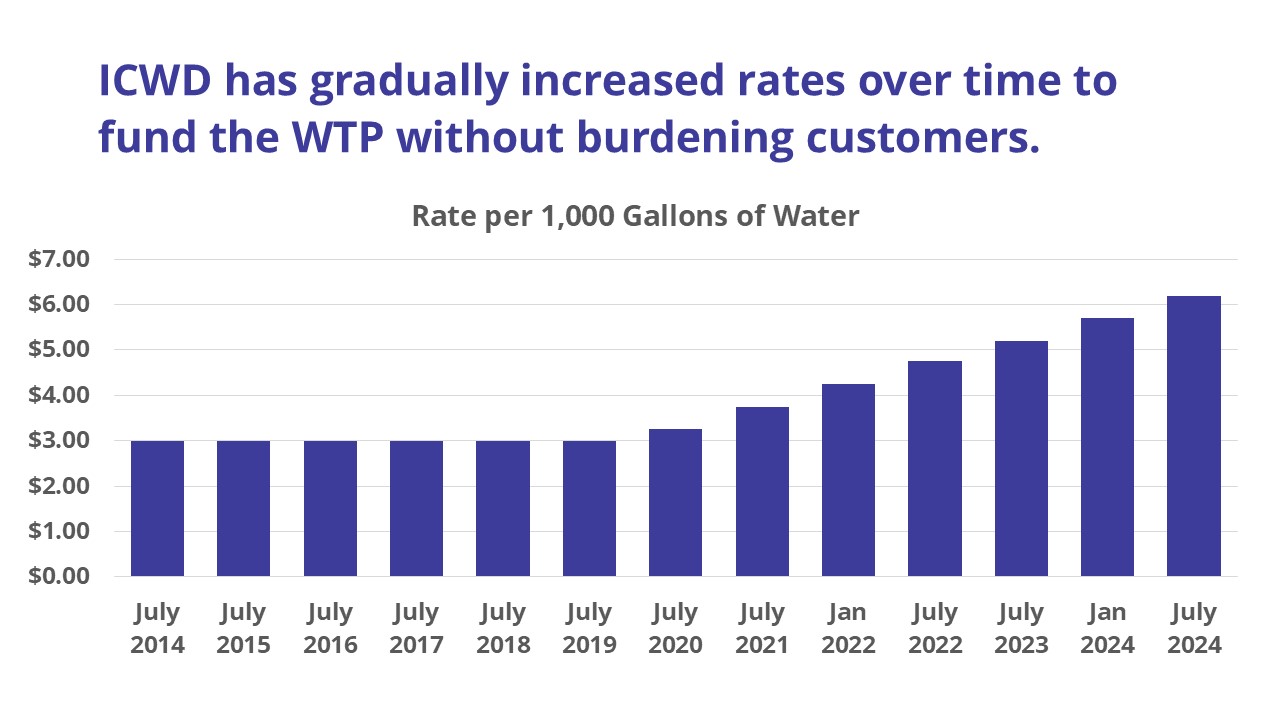
If I’m a customer of ICWD, will this debt cause my water rates to increase?
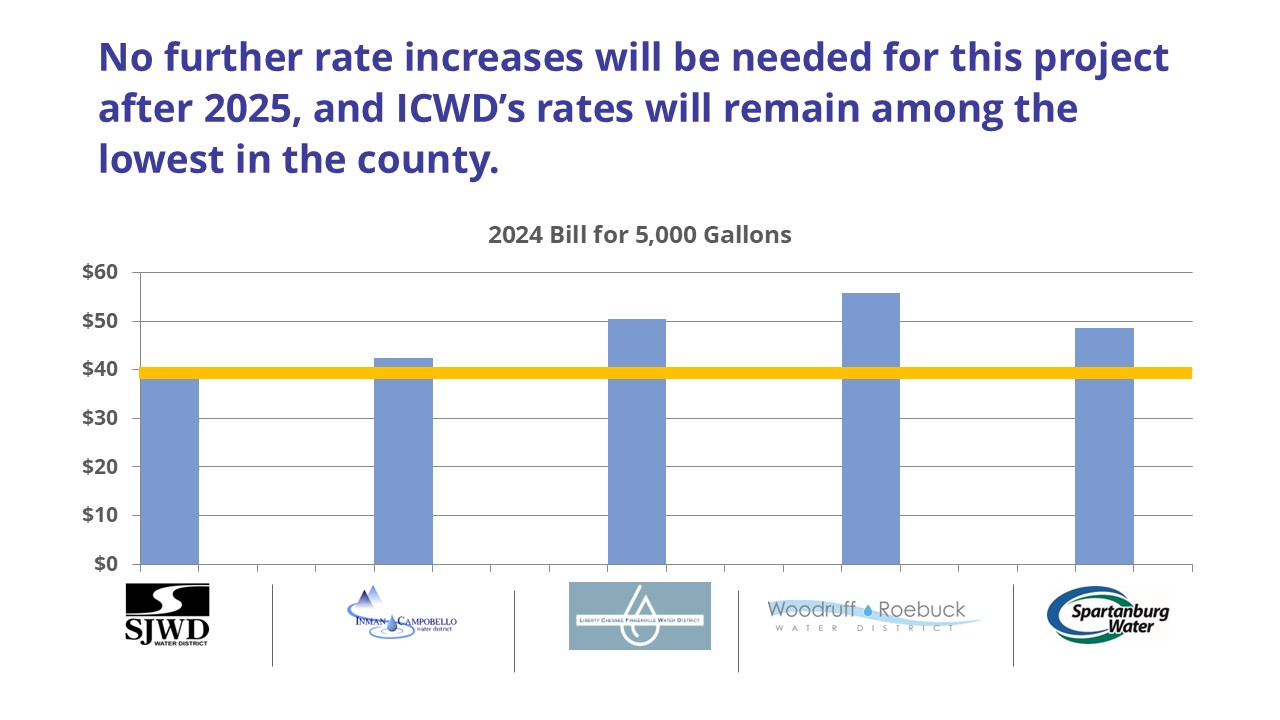
Since ICWD has raised rates, how does ICWD compare to other water providers in Spartanburg County?